
The Last HTGR Construction Permit Was Issued Before the NRC Existed
Intended for: Advanced reactor founders, licensing and QA leads, investors, and industrial energy buyers watching Long Mott as a signal for what comes next, and what it still has to prove.

Executive Summary
On November 9, 2026, the NRC issued a construction permit to Long Mott Energy for four X-energy Xe-100 high-temperature gas-cooled reactors at Dow's Seadrift Operations site in Calhoun County, Texas. It is the first HTGR construction permit in the United States in nearly 60 years, the NRC's first approval of a multimodule advanced reactor facility, its first pebble-bed core, its first design with online refueling, and its first HTGR reviewed under the risk-informed Licensing Modernization Project framework. The NRC finished on its 18-month schedule. The last time an HTGR received a U.S. construction permit, the regulator was the Atomic Energy Commission, and the plant was Fort St. Vrain in northern Colorado. Fort St. Vrain's history is a useful reminder that the HTGR's safety case was never what failed. Component reliability and plant availability were. The schedule was possible because of roughly six and a half years of pre-application engagement before the application was filed. This post covers what the NRC approved, why the pre-application homework made the schedule possible, why the LMP review matters for every advanced reactor that follows, what Fort St. Vrain can still teach, and what a construction permit does and doesn't settle.
What the NRC approved
Long Mott Generating Station will pair four Xe-100 units, each rated at 80 MWe and 200 MWt, for a total of 320 MWe. The plant is designed primarily to supply high-temperature steam to Dow's Seadrift operations, with surplus electricity going to the grid. The fuel is HALEU TRISO particles in graphite pebbles, cooled by helium.
The application was submitted in March 2025. NRC staff completed the final safety evaluation one month ahead of schedule, and Chairman Nieh noted that the agency "delivered on the 18-month schedule." It is the NRC's third advanced reactor construction permit of 2026, after TerraPower's Natrium in March and TVA's Clinch River BWRX-300 in September.
The list of firsts is long:
The first multimodule advanced reactor facility the NRC has approved.
The first pebble-bed core.
The first design with online refueling.
The first HTGR reviewed under the Licensing Modernization Project framework.
I co-authored the construction permit application for the Xe-100 earlier in my career, so this one is personal. It is also a milestone for anyone who has spent years arguing that non-light-water reactors can move through the NRC on a predictable timeline.
Eighteen months was the review. The homework took years.
The 18-month schedule is getting the attention, and the NRC deserves credit for meeting it. But the schedule was possible because of work that started long before the application was filed.
According to the NRC, its pre-application activities with X-energy began in September 2018, with a regulatory engagement plan on file by 2019. The construction permit application arrived in March 2025, roughly six and a half years later. In between, X-energy submitted roughly 30 topical reports and white papers, many in multiple revisions, covering the questions that would otherwise have surfaced as requests for additional information during the review:
The quality assurance program description
Principal design criteria
The risk-informed, performance-based licensing basis under NEI 18-04
TRISO-X pebble fuel qualification methodology
Graphite qualification and design methodology
Mechanistic source term
Transient and safety analysis methodologies, and qualification of the analysis codes
Reactor core design methods
PRA technical adequacy
Emergency planning zone sizing, atmospheric dispersion, and dose methodology
Control room staffing, training programs, and physical protection
When the NRC published the 18-month review schedule in 2025, X-energy noted that the agency cited the application's completeness, its quality, and the effectiveness of pre-application engagement. In other words, many of the hardest technical questions had already been raised, argued, and answered before the review clock started.
That's the lesson for every developer promising a short review schedule. The NRC can only review quickly what has already been made reviewable. Pre-application engagement is where that happens, and it can't be compressed into the months before you file.
Why the LMP review is the bigger precedent
The pebble bed and online refueling will get the headlines. For future applicants of non-LWR technology, the Licensing Modernization Project is the part that matters most.
LMP, documented in NEI 18-04 and endorsed by the NRC in Regulatory Guide 1.233, builds the licensing basis from the plant's own risk profile. Licensing basis events are selected and sorted by frequency and consequence. Safety classification of SSCs follows from their role in preventing and mitigating those events, including a category of non-safety-related SSCs that still receive special treatment because they matter to risk. Defense-in-depth is evaluated explicitly rather than assumed.
Until now, LMP had been tested on advanced reactor applications, but never on a gas-cooled reactor carried all the way to a construction permit. Long Mott shows the NRC can review an HTGR licensing basis built this way on schedule. That gives every developer using LMP, under Part 50 or Part 53, a reference point.
It also raises the bar. A risk-informed licensing basis is only as good as the PRA, the reliability data, and the special-treatment programs underneath it. When LMP classifies an SSC as non-safety-related with special treatment, the licensee owes the NRC proof that the SSC will actually perform as reliably as the PRA assumes. That proof comes from programs such as:
The Maintenance Rule (10 CFR 50.65), which requires monitoring the performance or condition of SSCs against established goals and taking corrective action when they fall short.
Reliability and Integrity Management (RIM), the ASME Section XI, Division 2 approach for passive components in advanced reactors, which sets reliability targets and the monitoring, inspection, and examination needed to meet them.
A reliability assurance program that carries the reliability assumptions in the PRA through design, procurement, and operation.
Targeted testing, inspection, and graded quality requirements applied to the specific SSCs and functions the PRA credits.
Those programs have to be real, documented, and maintained, not just described in an application. The PRA makes a promise. Special treatment is how the plant keeps it.
What Fort St. Vrain can still teach
The last U.S. HTGR to receive a construction permit was Fort St. Vrain, near Platteville, Colorado, north of Denver and not far from where Gibboney Nuclear is located. Construction began in 1968, under the Atomic Energy Commission. The NRC wouldn't exist for another seven years.
Fort St. Vrain built its safety case under 10 CFR Part 50, which the AEC first issued in 1956. Part 50 set the licensing pathway, but much of the detailed framework we take for granted today didn't exist yet. The quality assurance criteria in Appendix B weren't final until 1970, the General Design Criteria in Appendix A not until 1971, and the requirements that did emerge were written around light-water reactor technology. Fort St. Vrain's designers had to build an HTGR safety case largely from first principles, against a rulebook that was still being written for a different technology.
Long Mott had something Fort St. Vrain never did: a technology-inclusive method for building the licensing basis. That is the real distance between the two permits.
Fort St. Vrain was a 330 MWe helium-cooled reactor with prismatic graphite fuel. It delivered its first commercial power in 1979 and shut down in 1989. Its problems are well documented. Water from the helium circulators' water-lubricated bearings found its way into the primary system. Control rod drives corroded. Steam generators leaked. The plant spent long stretches offline, and its owner eventually decided that fixing the latest problem wasn't worth the cost. The site now hosts a natural gas plant, and spent fuel from the reactor is still stored there.
What failed at Fort St. Vrain wasn't the HTGR's safety case. It was component reliability, plant availability, and the cost of operating a one-of-a-kind machine. Those are exactly the risks a construction permit doesn't address.
The Xe-100 is a different design built with different technology, and I'm not suggesting Long Mott will repeat Fort St. Vrain's history. The point is narrower. The first U.S. HTGR construction permit in nearly 60 years arrives with the same open question the last one had: can the plant run reliably enough, for long enough, to pay for itself? That question gets answered in detailed design, procurement, construction, and operations, not in a safety evaluation.
What a construction permit settles, and what it doesn't
A Part 50 construction permit says the preliminary design and the site are acceptable for construction. It doesn't authorize operation, and it doesn't mean the design is frozen. Long Mott still needs a separate operating license before fuel load.
The commercial decision isn't made yet either. Dow has said several important milestones remain before construction could begin, including finishing engineering and design and review by its board. Dow expects to consider a preliminary investment decision in 2027, with construction possible later this decade and startup in the early 2030s.
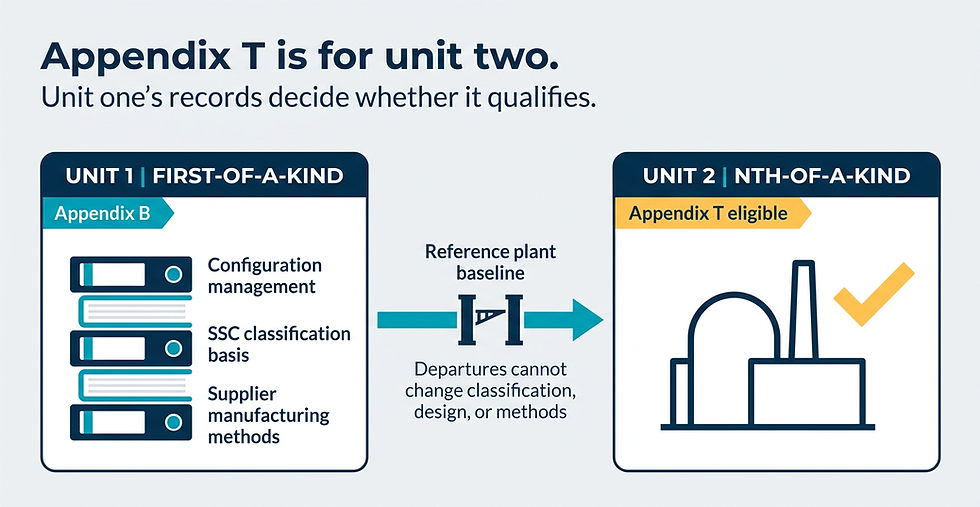
Between now and then, the critical path moves from licensing to configuration management. Detailed design has to mature under design control, procurement and commercial grade dedication have to hold to requirements that can't drift, and every change has to be traced from the preliminary safety analysis report to the final one the operating license review will read. For a multimodule plant, that discipline also has to keep four units consistent with each other.
What developers should do now
Use pre-application engagement to retire novel questions before you file. Every topical report or white paper the NRC has already reviewed is a question it doesn't have to ask on the clock. Plan your regulatory engagement in years, not months.
Build your LMP basis as architecture, not paperwork. If you plan to use LMP, start the PRA, licensing basis event selection, and SSC classification early, and design the special-treatment programs, such as Maintenance Rule monitoring and RIM, that your classification depends on.
Design for maintainability and reliability from the start. Fort St. Vrain's lesson is that availability is a design requirement. Treat component reliability, inspection access, and maintenance as licensing-adjacent decisions, because the business case depends on them.
Treat the construction permit as the start of configuration management. Stand up design control and requirements management before the permit, so the path from preliminary to final design is traceable when the operating license review asks.
Map your customer's decision gates. An industrial host like Dow has its own investment milestones. Align licensing, design maturity, and cost certainty with the points where your customer decides whether to build.
Plan standardization across units early. In a multimodule plant, every unit-to-unit difference is a configuration risk. Decide what is standard and what is site- or unit-specific before construction starts.
The bottom line
Long Mott proves an HTGR can move through a modern, risk-informed NRC review on schedule. That is real progress, and the people who did that work should be proud of it. What it doesn't prove yet is the thing Fort St. Vrain never managed to: that a high-temperature gas reactor can be built on budget and run reliably for decades. That part starts now.
Frequently Asked Questions
Q: What did the NRC approve for Long Mott?
A: On November 9, 2026, the NRC issued a construction permit to Long Mott Energy for four X-energy Xe-100 high-temperature gas-cooled reactors at Dow's Seadrift Operations site in Calhoun County, Texas. The permit authorizes construction, not operation.
Q: How large is the Long Mott Generating Station?
A: Four Xe-100 units, each rated at 80 MWe and 200 MWt, for a total of 320 MWe. The plant is designed primarily to supply high-temperature process steam to Dow, with surplus electricity to the grid.
Q: Why is it called the first HTGR construction permit in nearly 60 years?
A: The last U.S. high-temperature gas-cooled reactor to receive a construction permit was Fort St. Vrain in Colorado, where construction began in 1968 under the Atomic Energy Commission, before the NRC was created.
Q: Why was the NRC able to meet the 18-month schedule?
A: Largely because of pre-application work. NRC pre-application activities with X-energy began in September 2018, and X-energy submitted roughly 30 topical reports and white papers before filing the construction permit application in March 2025. The NRC cited the application's completeness, quality, and pre-application engagement when it set the schedule.
Q: What is the Licensing Modernization Project?
A: LMP is a risk-informed, performance-based method for developing an advanced reactor's licensing basis, documented in NEI 18-04 and endorsed by the NRC in Regulatory Guide 1.233. It selects licensing basis events and classifies SSCs based on frequency, consequence, and risk significance.
Q: What licensing framework did Fort St. Vrain use?
A: Fort St. Vrain was licensed under 10 CFR Part 50, first issued by the Atomic Energy Commission in 1956. When its construction began in 1968, the General Design Criteria (Appendix A) and quality assurance criteria (Appendix B) had not yet been finalized, and later requirements were written largely around light-water reactors.
Q: What are special treatment programs under LMP?
A: Programs that give the NRC confidence that risk-significant SSCs classified as non-safety-related will perform as the PRA assumes. Examples include Maintenance Rule monitoring under 10 CFR 50.65, Reliability and Integrity Management under ASME Section XI, Division 2, reliability assurance programs, and targeted testing and inspection.
Q: What happened to Fort St. Vrain?
A: Fort St. Vrain, a 330 MWe HTGR near Platteville, Colorado, produced commercial power from 1979 until 1989. Recurring equipment problems, including moisture entering the primary system from the helium circulators, kept availability low, and its owner shut it down. The site now hosts a natural gas plant.
Q: Does a construction permit mean the reactor can operate?
A: No. A Part 50 construction permit allows nuclear construction. Long Mott must obtain a separate NRC operating license before loading fuel or operating the reactors.
Q: When could Long Mott be built?
A: Dow has not made a final decision to build. It expects to consider a preliminary investment decision in 2027, with construction possible later this decade and startup in the early 2030s.
Q: What does Long Mott mean for other advanced reactor developers?
A: It shows the NRC can review a non-light-water, multimodule design using the LMP framework on a predictable schedule, which gives other LMP users a reference point. It doesn't remove the need for a strong PRA, special-treatment programs, configuration management, and a credible plan for reliable operation.
Sarah Gibboney, P.E., is Founder and Principal Licensing Engineer at Gibboney Nuclear, PLLC, a nuclear licensing consultancy supporting advanced reactor developers through NRC licensing strategy, QA program development, and commercialization readiness. She has 17 years of nuclear industry experience, including co-authoring Construction Permit Applications for TerraPower's Natrium and X-energy's Xe-100 reactors.
References
NRC News Release 26-083, "NRC Issues First Construction Permit in Nearly 60 Years for High-Temperature Gas-Cooled Reactor" (November 9, 2026). https://www.nrc.gov/about-nrc/news-releases/2026/26-083
ANS Nuclear Newswire, "NRC issues construction permit for Dow/X-energy Long Mott project." https://www.ans.org/news/article-8573/nrc-issues-construction-permit-for-dowxenergy-long-mott-project/
World Nuclear News, "US issues landmark construction permit for Texas SMR plant" (November 10, 2026). https://world-nuclear-news.org/articles/us-issues-landmark-construction-permit-for-texas-smr-plant
NRC, "Xe-100 Pre-Application Activities." https://www.nrc.gov/reactors/new-reactors/advanced/who-were-working-with/pre-application-activities/xe-100.html
X-energy, "NRC Publishes 18-Month Review Schedule for Xe-100 Construction Permit Application" (June 16, 2025). https://x-energy.com/?p=104
NRC News Release 26-079, "NRC Approves Construction of Nation's First Small Modular Reactor" (September 29, 2026). https://www.nrc.gov/about-nrc/news-releases/2026/26-079
NRC Regulatory Guide 1.233, "Guidance for a Technology-Inclusive, Risk-Informed, and Performance-Based Methodology to Inform the Licensing Basis and Content of Applications for Licenses, Certifications, and Approvals for Non-Light-Water Reactors."
AEC, "Licensing of Production and Utilization Facilities," 10 CFR Part 50, 21 FR 355 (January 19, 1956). https://archives.federalregister.gov/issue_slice/1956/1/19/353-355.pdf
"Fort St. Vrain Generating Station," Wikipedia. https://en.wikipedia.org/wiki/Fort_St._Vrain_Generating_Station
Decommissioning Collaborative, "Fort St. Vrain." https://decommissioningcollaborative.org/fort-st-vrain/


Comments