
The DOE-to-NRC Bridge Is Final. Your Data Still Has to Cross It.
Intended for: Founders, licensing leads, QA managers, and investors at advanced reactor developers running, or planning, a DOE or Department of War demonstration reactor with a commercial NRC license as the end goal.

Executive Summary
On October 22, 2026, the NRC finalized its first major reactor rule under Executive Order 14300. New 10 CFR 50.43(f) and revised 10 CFR 53.440(a)(1) let a commercial applicant include "consideration of relevant information" from a reactor previously authorized by DOE or the Department of War. The rule is a roadmap, not a waiver: the applicant must show how the prior authorization satisfies NRC regulations, explain every material difference between the demonstration and the commercial plant, and fill whatever gaps remain. The NRC does not delegate its review, though it may tailor the depth of review based on how well the applicant justifies relevance. Neither the proposed nor the final rule addresses the question that will decide how useful demonstration data really is: whether it was generated under a quality assurance program the NRC can rely on. And the streamlined QA alternative the NRC has proposed, Appendix T, would only become available after a first-of-a-kind plant is built under Appendix B. This post walks through what the final rule requires, where QA pedigree fits, how the full pathway from demonstration to fleet looks today, and what developers should do now.
What the NRC finalized
Earlier this year, I wrote about the NRC's draft interim staff guidance on DOE- and DOW-authorized designs. My read was that the guidance is best read as a roadmap, not a waiver, and that QA pedigree is the practical gate. The final rule confirms the first point. The second is still up to you.
The April proposed rule would have added a third option to 10 CFR 50.43(e), the requirement that new designs demonstrate the performance of their safety features through analysis, testing, operating experience, or a prototype. After 136 unique public comment submissions, the final rule moved the provision into its own paragraph, 50.43(f), and made parallel changes to 53.440(a)(1) for Part 53 applicants.
The operative language is permissive and narrow. An application "may include consideration of relevant information" from a utilization facility authorized by DOE or DOW, and "any reference to such a design must identify how attributes of the authorization satisfy NRC regulations."
May include. Consideration. Relevant. Each word puts the burden on the applicant.
What applicants must show
According to the final rule and the NRC's announcement, an applicant relying on a prior DOE or DOW authorization must:
Identify how the attributes of the prior authorization satisfy NRC regulations. A DOE authorization is evidence the NRC can consider, not a finding the NRC adopts.
Address differences between the demonstration and the proposed commercial project, including changes in design, functionality, hazards, siting, or safety assumptions.
Fill the gaps. Where the prior authorization doesn't supply information an NRC requirement needs, the application has to.
One improvement worth noting: when the draft guidance came out, it barely explored Part 53. The final rule revises 53.440(a)(1) directly, so Part 53 applicants now have an explicit hook for demonstration information too.
The rule offers examples of what an applicant may discuss: the scope of the prior authorization, including the testing, analyses, and operational experience it relied on; the safety functions and design features it addressed; and material differences in design, operation, or siting.
The NRC was explicit that nothing in the rule delegates its evaluation to DOE, DOW, or any other agency, and nothing allows it to forgo an independent review. What the NRC can do is tailor the focus and depth of its review based on how well the applicant justifies the relevance of the prior information. That is the real opportunity in this rule, and it is earned, not granted.
The question the rule doesn't answer: QA pedigree
Neither the April proposed rule nor the final rule text addresses quality assurance of demonstration data. The proposal didn't mention Appendix B, NQA-1, or DOE's own QA requirements, and it asked no questions about them. QA lives in the guidance instead. The NRC's draft interim staff guidance points applicants toward the Appendix B and NQA-1 framework, but as I noted when it came out, it doesn't define a universal evidence package. The burden of showing pedigree stays with the applicant.
That gap matters. DOE-authorized reactors operate under DOE's nuclear safety framework, including its own quality assurance requirements, not under 10 CFR 50 Appendix B. Test data is only as useful to an NRC reviewer as the controls it was generated under. A reviewer will want to know which QA program governed the test, how instruments were calibrated, how the as-tested configuration was controlled, and how the data traces to the design that is actually being licensed.
Test data without pedigree is a story, not evidence. The developers who get the deepest benefit from 50.43(f) will be the ones who can answer those questions on the first request.
Where Appendix T fits, and where it doesn't yet
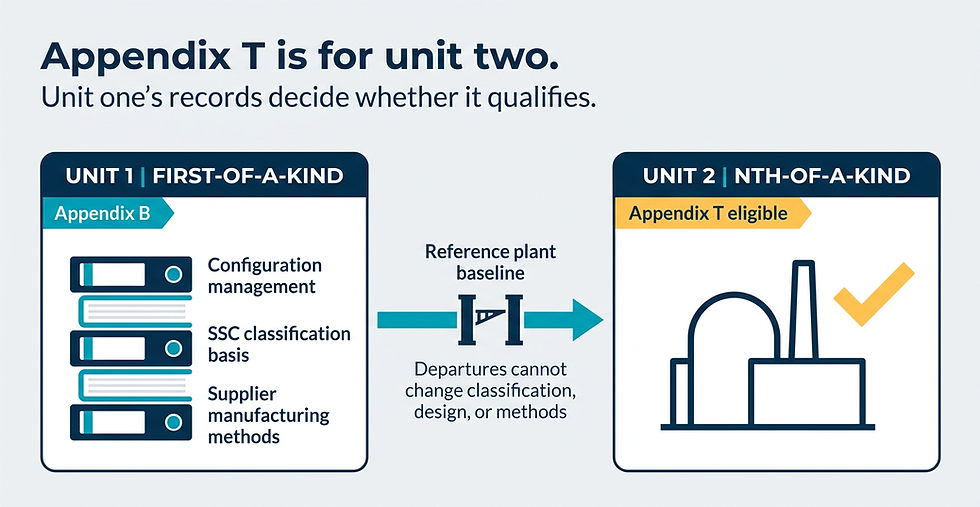
This rule is final. Appendix T is not. The NRC's proposed Appendix T to Part 50, "Streamlined Quality Assurance Criteria," would be a voluntary, performance-based alternative to Appendix B. As NRC staff presented the proposal, it can only be referenced by a Nth-of-a-kind application that identifies its first-of-a-kind reference plant, whose departures from that plant don't change SSC classification, design, or methods of manufacture, construction, and operation, and whose Appendix T procedures are already in the application.
Put the two rules together and the pathway, as it stands today, looks like this:
Demonstration. A DOE- or DOW-authorized reactor generates test data and operating experience under DOE or DOW oversight and QA requirements.
First-of-a-kind NRC plant. The commercial applicant uses 50.43(f) or 53.440(a)(1) to bring in relevant demonstration information, under an Appendix B QA program, and addresses every difference and gap.
Nth-of-a-kind plants. Once the FOAK exists as a reference plant, later units could reference Appendix T, if the final rule keeps its current structure.
The open question is whether a DOE-authorized demonstration reactor could ever serve as the FOAK reference plant for Appendix T. Nothing in the materials I've reviewed says it can, and the proposal's structure points to an NRC-licensed plant built under Appendix B. Industry commenters have pushed for Appendix T to cover FOAK plants as well. Until the final rule settles it, plan on the demonstration feeding the FOAK license, not substituting for it.
That makes the demonstration's configuration and QA records do double duty. They support the first NRC license through 50.43(f), and through that license, they become part of the baseline every later unit will be measured against.
What developers should do now
Treat every test as future NRC evidence. Before you run it, know which NRC requirement each result is meant to support. A test plan written with the NRC application in mind is far easier to reference than one reverse-engineered later.
Map your DOE QA program to Appendix B now. Do the regulatory crosswalk while records can still be fixed and gaps can still be closed, not when a reviewer asks.
Put the demonstration and commercial designs under one configuration baseline. Log every difference as you make it. The rule requires you to explain those differences, and that list is much harder to build after the fact.
Record the as-tested configuration and test conditions. Calibration records, instrument uncertainty, and the exact configuration tested are what turn results into evidence.
Engage the NRC early on how you'll use the data. Pre-application meetings are the place to agree on which demonstration results you intend to rely on and what the NRC will expect to see.
Plan the fleet path deliberately. Build your FOAK QA program and configuration management knowing they may become the reference for Appendix T, and watch the final Appendix T rule for any change to FOAK eligibility.
The bottom line
Several DOE-authorized reactors reached criticality this year. The ones that move fastest through the NRC won't be the ones that tested the most. They'll be the ones that can prove what they tested, and show exactly how it applies to the plant they want to license.
Frequently Asked Questions
Q: What does the NRC's final rule on DOE and DOW demonstration data do?
A: Finalized October 22, 2026, it adds 10 CFR 50.43(f) and revises 10 CFR 53.440(a)(1) so commercial applicants may include consideration of relevant information, such as analyses, test data, and operating experience, from reactors previously authorized by DOE or the Department of War.
Q: Does a DOE authorization mean the NRC will approve the design?
A: No. The NRC states that the rule does not delegate its evaluation to DOE or DOW and does not allow it to skip an independent review. A DOE authorization is evidence an applicant can use, not a finding the NRC adopts.
Q: What must an applicant show to use DOE or DOW demonstration information?
A: The applicant must identify how attributes of the prior authorization satisfy NRC regulations, address differences in design, functionality, hazards, siting, or safety assumptions between the demonstration and the commercial plant, and fill any gaps the demonstration doesn't cover.
Q: Does the rule shorten NRC review?
A: It can. The NRC may tailor the focus and depth of its review based on how well the applicant justifies the relevance of the prior information. The benefit depends on the quality of that justification.
Q: Does the rule address quality assurance of demonstration data?
A: Not in the rule text. Neither the proposed nor the final rule discusses Appendix B, NQA-1, or DOE QA requirements. The NRC's draft interim staff guidance on DOE- and DOW-authorized designs is where QA expectations appear, and applicants should expect reviewers to ask how demonstration data was controlled and traced.
Q: Can a DOE demonstration reactor be the reference plant for Appendix T?
A: Not based on the proposal as NRC staff presented it. Appendix T, which is still proposed, applies to Nth-of-a-kind plants that reference a first-of-a-kind reference plant, and its structure points to an NRC-licensed plant built under Appendix B. The final Appendix T rule could change that.
Q: When does the final rule take effect?
A: Thirty days after publication in the Federal Register. The NRC expected publication in late October 2026.
Q: Which reactors could generate demonstration data under this rule?
A: Reactors authorized by DOE, such as those in DOE's reactor pilot program, and reactors authorized by the Department of War. Participation does not automatically qualify an applicant for expedited NRC review.
Q: What should a developer running a DOE demonstration do now?
A: Treat every test as future NRC evidence, map the DOE QA program to Appendix B, keep the demonstration and commercial designs under one configuration baseline, record as-tested conditions, and engage the NRC early on how the data will be used.
Sarah Gibboney, P.E., is Founder and Principal Licensing Engineer at Gibboney Nuclear, PLLC, a nuclear licensing consultancy supporting advanced reactor developers through NRC licensing strategy, QA program development, and commercialization readiness. She has 17 years of nuclear industry experience, including co-authoring Construction Permit Applications for TerraPower's Natrium and X-energy's Xe-100 reactors.
References
Gibboney Nuclear, "From DOE Authorization to NRC Licensing." https://www.gibboneynuclear.com/post/from-doe-authorization-to-nrc-licensing
NRC News Release 26-081, "NRC Finalizes Rule to Streamline Licensing for Reactor Designs Tested by DOE or DOW" (October 22, 2026). https://www.nrc.gov/about-nrc/news-releases/2026/26-081
NRC, final rule, "NRC Reviews of Reactor Designs Previously Authorized by U.S. Department of Energy or Department of War" (ML26295A067). https://www.nrc.gov/docs/ML2629/ML26295A067.pdf
NRC, proposed rule, "NRC Reviews of Reactor Designs Previously Authorized by U.S. Department of Energy or Department of Defense," 91 FR 16584 (April 2, 2026), Docket NRC-2025-1503. https://www.govinfo.gov/content/pkg/FR-2026-04-02/html/2026-06414.htm
POWER, "NRC Finalizes Rule Allowing Reactor Applicants to Use DOE, DOW Demonstration Data." https://www.powermag.com/nrc-finalizes-rule-allowing-reactor-applicants-to-use-doe-dow-demonstration-data/
NRC, "Modernizing Reactor Licensing, Safety Oversight, and Siting Practices," proposed rule, 91 FR 44560 (July 16, 2026), Docket NRC-2025-0975. https://www.federalregister.gov/documents/2026/07/16/2026-14341/modernizing-reactor-licensing-safety-oversight-and-siting-practices
D. Bollock, NRC Vendor and Quality Assurance Branch, "NRC's Regulatory Update" (ML26218A126). https://www.nrc.gov/docs/ML2621/ML26218A126.pdf


Comments