
Appendix T Is for Unit Two. Build Unit One Like You Know That.
Intended Audience: Founders, QA managers, licensing leads, and investors at advanced reactor developers building a first-of-a-kind plant with a fleet in mind, and suppliers deciding whether to pursue nuclear work.
Executive Summary
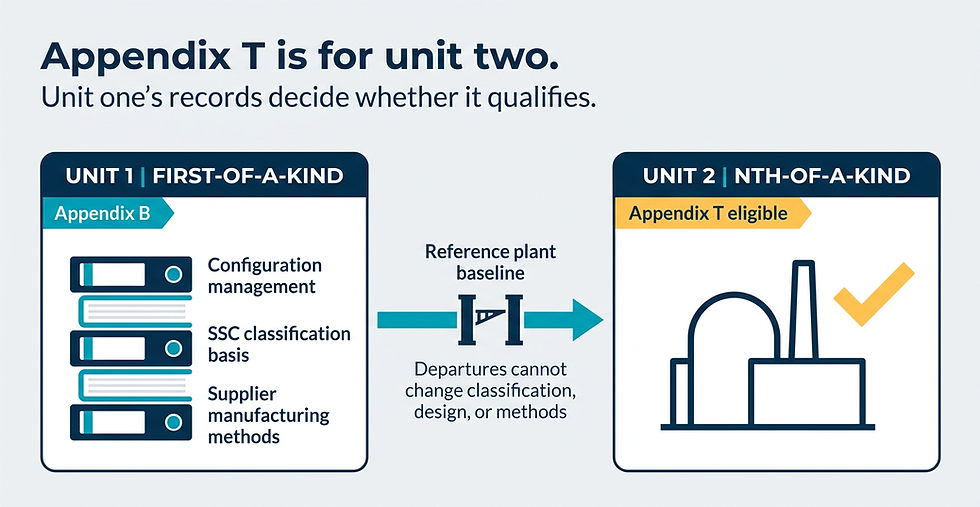
The NRC has proposed Appendix T to 10 CFR Part 50, a streamlined, performance-based alternative to 10 CFR Part 50, Appendix B with an explicit graded approach and no need for NRC oversight of suppliers for SSCs in its scope. Like other recent NRC rulemakings, the catch is eligibility. As NRC staff presented the proposal, Appendix T can only be referenced by a Nth-of-a-kind application that identifies its first-of-a-kind reference plant, already docketed and approved by the NRC, whose departures from that plant don't change SSC classification, design, or methods of manufacture, construction, and operation, and whose Appendix T procedures are already in the application. For most advanced reactor developers, that means Appendix B still governs unit one, and unit one's configuration management, classification basis, and supplier control become the baseline that decides whether every later unit qualifies. This post covers what Appendix T would change, who it is actually for, what remains unknown before the final rule, and what first-of-a-kind developers should do now.
In July, the NRC proposed something quality assurance professionals have talked about for years: an alternative to Appendix B.
Proposed Appendix T to 10 CFR Part 50, "Streamlined Quality Assurance Criteria for Nuclear Power Plants and Fuel Reprocessing Plants," was published on July 16, 2026, as part of the NRC's "Modernizing Reactor Licensing, Safety Oversight, and Siting Practices" proposed rule. The comment period closed August 31. NRC staff have estimated a final rule in December 2026.
It is easy to read "streamlined QA" and assume relief is coming for every advanced reactor developer. It isn't. As NRC staff presented the proposal, Appendix T can only be referenced in an application for a Nth-of-a-kind plant, one that identifies its first-of-a-kind reference plant and every departure from it.
Most advanced reactor developers are still building unit one. For them, Appendix B is not going anywhere. What Appendix T does is offer a path to decrease cost once they prove they can build it well.
What the NRC has proposed
Based on the proposed rule's summary and NRC staff presentations, Appendix T would:
Be a voluntary alternative to Appendix B for applicants who meet specific eligibility criteria.
Establish performance-based QA criteria, with explicit direction on applying a graded approach based on each SSC's safety and risk contributions.
Draw on international quality assurance standards and terminology used in other safety-critical industries.
Include QA requirements for software used in digital items and in design and analysis.
Increase licensing certainty by removing the need for NRC oversight of suppliers and vendors for SSCs within its scope.
The eligibility criteria
According to the NRC Vendor and Quality Assurance Branch's presentation of the proposal, an applicant for a construction permit, operating license, or combined license must demonstrate all three of the following to reference Appendix T:
It is a Nth-of-a-kind application. The application identifies the first-of-a-kind (FOAK) reference plant and any departures from it.
Departures don't change what matters. Departures from the FOAK reference plant do not change the classification, design, and method of manufacture, construction, and operation of SSCs within the scope of the appendix.
The program already exists. Procedures and work processes for implementing Appendix T have been established and included in the application.
Read those together and the logic is clear. The NRC is willing to streamline QA, and step back from supplier oversight, for a plant whose design, classification, and manufacturing methods have already been proven once under Appendix B. Appendix T is not a shortcut around the first unit. It is a cost savings dividend paid on it.
Why this makes unit one's QA program more important
If your second plant's QA regime depends on showing that it doesn't depart from your first plant in classification, design, or method of manufacture, construction, or operation, then your first plant's records become the baseline for everything that follows.
That puts three things on the critical path for FOAK developers:
Configuration management. You can only show a NOAK plant doesn't depart from its reference plant if you know, precisely, what the reference plant is. A FOAK design that drifted through construction without disciplined design control has no clean baseline to compare against.
SSC classification records. The second criterion turns on whether classification changes. The basis for each SSC's classification on unit one needs to be documented well enough that someone can prove, years later, it still applies.
Manufacturing and construction methods. "Method of manufacture" is in the criteria. If a supplier changes processes between units, that may be a departure that matters. Supplier control on unit one is how you know what the baseline method was.
This is the same thesis I keep coming back to: the gap between a licensable design and a construction-ready, frozen design is where first-of-a-kind projects lose time and money. Ineligibiliy to use Appendix T for future units would add a lost opportunity cost to that gap. A FOAK project that never really froze its design may struggle to qualify its own successors for the streamlined path.
A graded approach isn't new. Using it is.
None of this means FOAK developers should build bloated programs. Appendix B has always allowed grading. Its introduction applies the criteria to safety-related functions "to an extent consistent with their importance to safety."
Most advanced reactor QA programs I review are not under-built. They are over-built in the wrong places. A 10-person startup copies a QA program description from an operating utility or a fuel cycle facility, since that is what AI chatbots are learning from, inherits a few hundred procedures it cannot staff, and then quietly stops following half of them. A developer moving from concept into licensing typically needs 25 to 30 strong core procedures that can scale, with the rigor concentrated on the activities that generate safety-related design information and that define the baseline a future NOAK plant will reference.
The supply chain question
Removing the need for NRC oversight of suppliers for NOAK plants could matter a great deal to the industrial base. Many capable manufacturers have never worked to Appendix B, and the pool of qualified nuclear suppliers is narrow.
The NRC asked commenters two related questions worth watching: whether vendor inspections should still apply to FOAK plants and to new suppliers for NOAK plants, and whether the NRC should consider endorsing ISO 19443, the nuclear sector's quality management standard built on ISO 9001, as an alternative.
Either answer reinforces the same point. Supplier oversight doesn't disappear when the NRC steps back. It moves to the licensee, and it rests on the baseline established for the first unit.
What we don't know yet
Whether the eligibility criteria survive into the final rule unchanged. The NRC specifically asked whether they, and Appendix T's voluntary status, should change.
How a "FOAK reference plant" will be defined in practice, including how far along it must be before a NOAK application can reference it.
How the NRC will judge whether a departure changes classification, design, or method of manufacture, construction, or operation.
How programs and records developed under Appendix B and NQA-1 will transition.
What developers should do now
Keep building under Appendix B and NQA-1. If you are building unit one, you don't have a choice, and safety-related design work you generate today needs QA pedigree today.
Treat unit one as a reference plant from day one. Build configuration management and design control as if a future application will have to prove, item by item, what your first plant was. Because it will.
Document your classification basis. Record why each SSC is classified the way it is, not just the result. That basis is what a NOAK applicant will need to show hasn't changed.
Control manufacturing methods through your suppliers. Know and record the method of manufacture for in-scope SSCs on unit one, and require suppliers to notify you before they change it.
Grade now. Use the graded approach Appendix B already permits. Concentrate rigor where it protects safety and the future baseline.
Organize your QA program description by function. Procedures built around what your organization actually does make a later move to Appendix T a crosswalk and a revision, not a rewrite, and Appendix T requires those procedures to be in the application.
The bottom line
Appendix T may change the vocabulary of quality assurance for the plants that come second. It doesn't change the job for the plant that comes first. QA is how design intent survives contact with licensing, procurement, and construction, and under this proposal, it is also how unit one earns a simpler path for every unit after it.
Frequently Asked Questions
Q: What is Appendix T to 10 CFR Part 50?
A: Appendix T, "Streamlined Quality Assurance Criteria for Nuclear Power Plants and Fuel Reprocessing Plants," is a proposed NRC quality assurance appendix published July 16, 2026 (91 FR 44560). It would provide performance-based QA criteria with an explicit graded approach as a voluntary alternative to Appendix B.
Q: Does Appendix T replace Appendix B?
A: No. As proposed, Appendix T is a voluntary alternative available only to applicants that meet its eligibility criteria. Appendix B remains the QA requirement for everyone else, including first-of-a-kind plants.
Q: Who is eligible to use Appendix T?
A: As NRC staff presented the proposal, an applicant must show three things: the application is for a Nth-of-a-kind plant that identifies its first-of-a-kind reference plant and any departures; those departures don't change the classification, design, or method of manufacture, construction, and operation of in-scope SSCs; and Appendix T procedures and work processes are established and included in the application.
Q: Can a first-of-a-kind advanced reactor use Appendix T?
A: Not as proposed. Eligibility requires a Nth-of-a-kind application that references a first-of-a-kind plant. A FOAK developer would build its first unit under Appendix B, and that unit's QA and configuration management records would become the baseline for any later Appendix T application.
Q: Does Appendix T remove NRC oversight of nuclear suppliers?
A: For SSCs within its scope, the proposal would remove the need for NRC oversight of suppliers and vendors. Responsibility for supplier quality doesn't disappear; it rests with the licensee. The NRC also asked whether vendor inspections should still apply to FOAK plants and new suppliers for NOAK plants.
Q: How does Appendix T relate to NQA-1 and ISO standards?
A: The proposal draws on international quality assurance standards, and the NRC asked whether it should consider endorsing ISO 19443, the nuclear sector's quality management standard built on ISO 9001. NQA-1 remains the standard most U.S. programs use to implement Appendix B.
Q: Does Appendix B already allow a graded approach to QA?
A: Yes. Appendix B applies its criteria "to an extent consistent with their importance to safety." Appendix T would add explicit direction on grading by safety and risk significance, but developers can and should grade their Appendix B programs today.
Q: When will Appendix T be final?
A: The comment period closed August 31, 2026, and NRC staff estimated a final rule in December 2026. The NRC asked whether the eligibility criteria and voluntary status should change, so the final appendix may differ from the proposal.
Q: What should a first-of-a-kind developer do now?
A: Keep building under Appendix B and NQA-1, treat unit one as a future reference plant, document the basis for every SSC classification, control supplier manufacturing methods, apply a graded approach, and organize the QA program description by function so a later move to Appendix T is a revision, not a rewrite.
Sarah Gibboney, P.E., is Founder and Principal Licensing Engineer at Gibboney Nuclear, PLLC, a nuclear licensing consultancy supporting advanced reactor developers through NRC licensing strategy, QA program development, and commercialization readiness. She has 17 years of nuclear industry experience, including co-authoring Construction Permit Applications for TerraPower's Natrium and X-energy's Xe-100 reactors.
References
NRC, "Modernizing Reactor Licensing, Safety Oversight, and Siting Practices," proposed rule, 91 FR 44560 (July 16, 2026), Docket NRC-2025-0975. https://www.federalregister.gov/documents/2026/07/16/2026-14341/modernizing-reactor-licensing-safety-oversight-and-siting-practices
D. Bollock, NRC Vendor and Quality Assurance Branch, "NRC's Regulatory Update," presentation (ML26218A126). https://www.nrc.gov/docs/ML2621/ML26218A126.pdf
NRC, "Public Meeting: Executive Order 14300 Proposed Rule" slides (ML26208A057). https://www.nrc.gov/docs/ML2620/ML26208A057.pdf
10 CFR Part 50, Appendix B, "Quality Assurance Criteria for Nuclear Power Plants and Fuel Reprocessing Plants." https://www.law.cornell.edu/cfr/text/10/appendix-B_to_part_50


Comments