
The Nuclear Option Data Centers Are Overlooking
Intended audience: Data center operators, hyperscaler infrastructure teams, and energy procurement decision-makers evaluating nuclear power as a long-term baseload solution.
Executive Summary
Every conversation about nuclear power for data centers starts with the same assumption: 8–12 years to commercial operation. That assumption is correct for developers starting the licensing process today. It is not correct for all designs currently on the market. On May 29, 2025, the NRC issued Standard Design Approval for the NuScale US460 — the only SMR design in the United States to have completed NRC technical review. For a data center operator willing to engage directly as a project offtaker, the timeline math looks materially different than the industry narrative suggests. This post explains what Standard Design Approval means, why the UAMPS project collapse does not indict the technology, and what a data center operator should be asking before signing a 20-year gas contract.
What "8–12 Years to Operation" Actually Means — and When It Applies
At the 7x24 Exchange Spring Conference in June 2026, I had versions of the same conversation a dozen times with data center designers, constructors, and operators. Their interest in nuclear is real. Their timeline expectations needed calibrating.
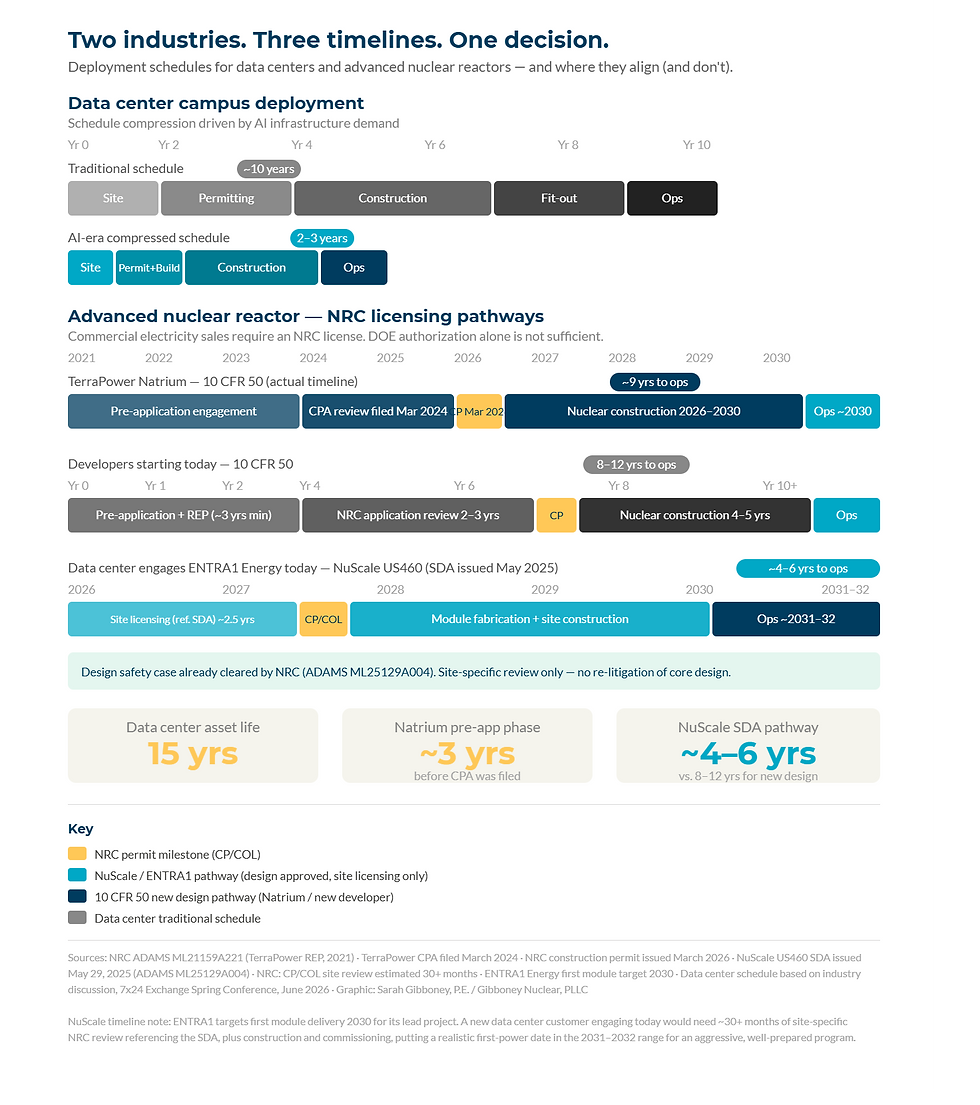
The 8–12 year figure is accurate for a developer pursuing NRC licensing on a new design under 10 CFR Part 50 today. Here is what that timeline actually contains:
Pre-application engagement: Before a formal application can be filed, a developer must conduct substantive pre-application engagement — white papers, regulatory engagement plans, topical reports, pre-application meetings. This phase takes a minimum of 2–3 years for a well-prepared team. TerraPower conducted approximately 60 pre-application engagements with the NRC before filing the Natrium CPA in March 2024, per TerraPower SVP George Wilson — nearly three years after submitting its Regulatory Engagement Plan in 2021 (ADAMS ML21159A221).
NRC application review: Under 10 CFR Part 50, NRC staff review of a Construction Permit Application takes 2–3 years. TerraPower's CPA, filed March 2024, resulted in a Construction Permit issued March 2026.
Construction and commissioning: The Natrium plant at Kemmerer, Wyoming is targeting commercial operation in 2030 — four years after CP issuance, nine years after formal NRC engagement began.
Total for a developer starting today: 8–12 years is the realistic range for a program with strong licensing discipline and no major regulatory surprises.
This is the answer that lands in the room. It is also incomplete.
The Design That Already Ran the Regulatory Gauntlet
On May 29, 2025, the NRC issued Standard Design Approval for the NuScale US460 (ADAMS ML25129A004). The NRC completed its technical review in less than two years — ahead of schedule. The Final Safety Evaluation Report is at ML25086A073. The Advisory Committee on Reactor Safeguards reviewed the SER with no open items (ML25136A329).
What Standard Design Approval means under 10 CFR Part 52, Subpart E: The NRC has completed its technical review of the design and found it acceptable. A future applicant referencing this SDA can file a construction permit, operating license, or combined license application without re-litigating the core design safety case. The SDA is valid for 15 years from May 29, 2025.
What it does not mean: SDA is not a construction permit or operating license. A new applicant still needs to complete site-specific environmental review, site characterization, and a formal licensing proceeding. The NRC estimates this process takes 30+ months at current staffing.
SDA vs. Design Certification: These are distinct under 10 CFR Part 52. Design Certification (Subpart B) is codified as a rule and carries stronger finality protections — approved design issues generally cannot be re-litigated in subsequent proceedings. Standard Design Approval (Subpart E) is an NRC staff approval that can be referenced but does not carry the same rulemaking finality. The NuScale US600 received Design Certification in 2020; the US460 received SDA in May 2025. Both clear the design's safety case. The DC provides stronger protection against re-litigation in a contested proceeding.
The US460 design: 77 MWe per module, scalable to 462 MWe across six modules (1,500 MWt total).
Why the UAMPS Collapse Is Not the Story You Think It Is
The Carbon Free Power Project — NuScale's first commercial deployment attempt with Utah Associated Municipal Power Systems at Idaho National Laboratory — was terminated in November 2023. For many observers, this ended the NuScale story.
It should not have.
The CFPP collapsed because small municipal utilities in competitive retail power markets could not absorb first-of-a-kind cost risk when the LCOE estimate rose from $55/MWh to $89/MWh. That is a rational decision for that customer profile. It tells you nothing about whether the technology works or whether a different buyer with a different cost structure would reach a different conclusion. The NRC design review process continued unaffected. The SDA was issued on schedule.
Data Centers Are a Different Customer Profile
Municipal utilities and hyperscale data center operators are not the same buyer.
Utilities operate under rate regulation and recover costs through retail rates. Cost overruns must be passed to ratepayers. Limited tolerance for FOAK risk is structural, not a failure of nerve.
Data center operators sign long-term power purchase agreements or own generation assets directly. They have committed capital, multi-decade facility lifecycles, and a specific need for reliable, carbon-free baseload that does not depend on fuel supply chains. In ERCOT, industrial users sit at the bottom of the natural gas curtailment priority stack — below hospitals, residences, and gas plants. A privately owned nuclear plant eliminates that exposure entirely.
The cost structure that failed with UAMPS is a different proposition when the buyer has a 20-year load commitment, a balance sheet capable of participating in project finance, and an energy security problem that gas cannot solve.
What Small Teams Should Do Now
If you are a data center energy procurement professional evaluating long-term power strategy:
Review the NRC pre-application activity page to understand which designs are doing substantive regulatory work vs. generating headlines
Request the US460 SDA documentation (ML25129A004) and the Final Safety Evaluation Report (ML25086A073) as your baseline for evaluating design maturity
Engage ENTRA1 Energy directly as the commercialization partner for the US460
Do not sign a 20-year gas infrastructure commitment before modeling a nuclear alternative with a design that has already cleared NRC review
The licensing record is the truth. One design has run the regulatory gauntlet. That fact should be in the room when long-term energy decisions are being made.NuScale and its commercialization partner ENTRA1 Energy are in advanced discussions with hyperscalers and are targeting first module delivery in 2030. The TVA program announced in September 2025 — up to 6 GW of NuScale SMR capacity across TVA's seven-state service region — is explicitly positioned to serve data center and AI infrastructure demand.
Frequently Asked Questions
Q: What is the difference between NRC Standard Design Approval and Design Certification?
A: Both are NRC approvals of a reactor design's safety case, but they carry different regulatory weight. Design Certification (10 CFR Part 52, Subpart B) is codified as a rule in the Code of Federal Regulations and provides finality protections — approved design issues generally cannot be re-litigated. Standard Design Approval (Subpart E) is an NRC staff approval that can be referenced in a CP, OL, COL, or ML application but does not carry the same rulemaking finality. The US460 received SDA on May 29, 2025 (ADAMS ML25129A004).
Q: Does NRC design approval mean a reactor can be built immediately?
A: No. SDA or Design Certification means the NRC has accepted the reactor design's safety case. A specific facility still requires site-specific environmental review and a separate NRC licensing proceeding. The NRC estimates 30+ months for this process at current staffing.
Q: Why did the UAMPS project fail, and does that affect the technology?
A: The CFPP was terminated in November 2023 because the project lacked sufficient subscriber commitments from UAMPS member utilities after cost estimates rose sharply. The NRC design review process was unaffected. The CFPP failure reflects a customer profile mismatch, not a technology or regulatory failure.
Q: What is ENTRA1 Energy?
A: ENTRA1 is NuScale's exclusive global commercialization partner, holding the global exclusive rights to deploy NuScale SMRs. Data center operators evaluating the US460 would engage through ENTRA1, which structures and finances ENTRA1 Energy Plants. NuScale functions as the technology and engineering provider; it does not sell electricity directly.
Q: What is NuScale's current deployment timeline?
A: NuScale is targeting first module delivery in 2030 per multiple 2025–2026 investor filings. A new customer site engaging today would need to complete site-specific licensing (30+ months per NRC) in addition to referencing the SDA — putting a realistic first-power date in the 2028–2032 range for a well-prepared program.
Q: How does nuclear compare to gas for a 20-year data center power commitment?
A: A gas plant under construction today faces turbine lead times that have stretched from roughly 2–3 years to as long as 7 years as of late 2025, according to both Utility Dive and S&P Global reporting, with data center demand driving a significant portion of that surge. Chevron and Microsoft signed a 20-year natural gas power purchase agreement in June 2026 for a West Texas data center campus — the same term length that a nuclear power plant's 40–60 year operating license would cover twice over. Natural gas price exposure runs the life of the contract, and industrial users in markets like ERCOT sit at the bottom of the fuel curtailment priority stack. Nuclear has higher upfront capital costs and a longer development timeline, but eliminates fuel price risk, grid curtailment exposure, and carbon liability for 40–60 years.
Sarah Gibboney, P.E. is the Founder of Gibboney Nuclear, PLLC. She has 17 years of nuclear energy experience, has co-authored Construction Permit Applications for both ARDP awardees, and maintains a proprietary global dataset of 170+ advanced reactor designs. Learn more at gibboneynuclear.com.


Comments